
A multi-site field services operator across regional New South Wales needed one staff-facing portal to replace fragmented spreadsheets, email approvals, and three disconnected legacy tools. Small Pea Software delivered a unified web application that centralised job intake, scheduling visibility, site compliance checks, and executive reporting without forcing a rip-and-replace of their finance platform.
Client Context
The organisation operates maintenance and inspection services across fourteen depots from the Central Coast through to the Riverina. Each depot had evolved its own habits: shared drives for job folders, WhatsApp threads for urgent reallocations, and a ageing desktop application that only synced nightly. Head office lacked same-day visibility into backlog, SLA risk, and technician utilisation. Leadership wanted a single operational source of truth while keeping their established cloud accounting system for invoicing and payroll.
Staff turnover in regional areas made tribal knowledge fragile. New coordinators spent weeks learning unofficial workarounds. Compliance audits exposed inconsistent record-keeping between sites — missing photos, unsigned checklists, and incomplete close-out notes. The client engaged Small Pea Software after a failed attempt to configure a generic project management product that could not represent their contract-specific pricing tiers or statutory inspection templates.
Problems to Solve
Duplicate data entry consumed an estimated twelve hours per depot per week. Coordinators re-keyed job details from email into spreadsheets, then again into the legacy system for billing export. Approval chains for non-standard pricing or after-hours dispatch lived in inboxes with no audit trail. Managers could not answer basic questions — how many jobs are overdue in Wagga, which clients have open defects, who approved yesterday's emergency call-out — without phone calls and manual tallies.
Integration gaps meant finance received batch files with formatting errors that delayed invoicing. Field technicians photographed completed work on personal phones; images rarely attached to the correct job record. Reporting for board meetings required two days of manual consolidation each month.
Technical Approach
We designed a modular web application hosted in an Australian cloud region with role-based access for coordinators, technicians, depot managers, and executives. Job records became the hub entity linking client sites, assets, assigned crews, checklist templates, attachments, and approval history. Real-time APIs connected to the finance platform for customer master sync and invoice export, while operational data remained authoritative in the portal.
Mobile-responsive forms allowed technicians to complete inspections offline with later sync when connectivity returned — critical for rural NSW coverage gaps. Checklist logic enforced mandatory fields before job closure. Document storage used encrypted object storage with retention policies aligned to contract and regulatory requirements.
Challenges
Legacy data quality was uneven. Fifteen years of client records included duplicates, deprecated site codes, and free-text addresses that geocoding could not resolve automatically. We implemented a staged cleansing workflow with depot managers validating merges before cutover. Parallel running for six weeks exposed definition mismatches between "complete" in operations versus "ready to invoice" in finance — resolved through explicit status gates and reconciliation dashboards.
Change resistance peaked at two depots accustomed to full autonomy. We paired super-users from high-adoption sites with reluctant teams and adjusted rollout order rather than forcing a single big-bang date. Training emphasised time saved on duplicate entry rather than abstract efficiency metrics.

Solutions Delivered
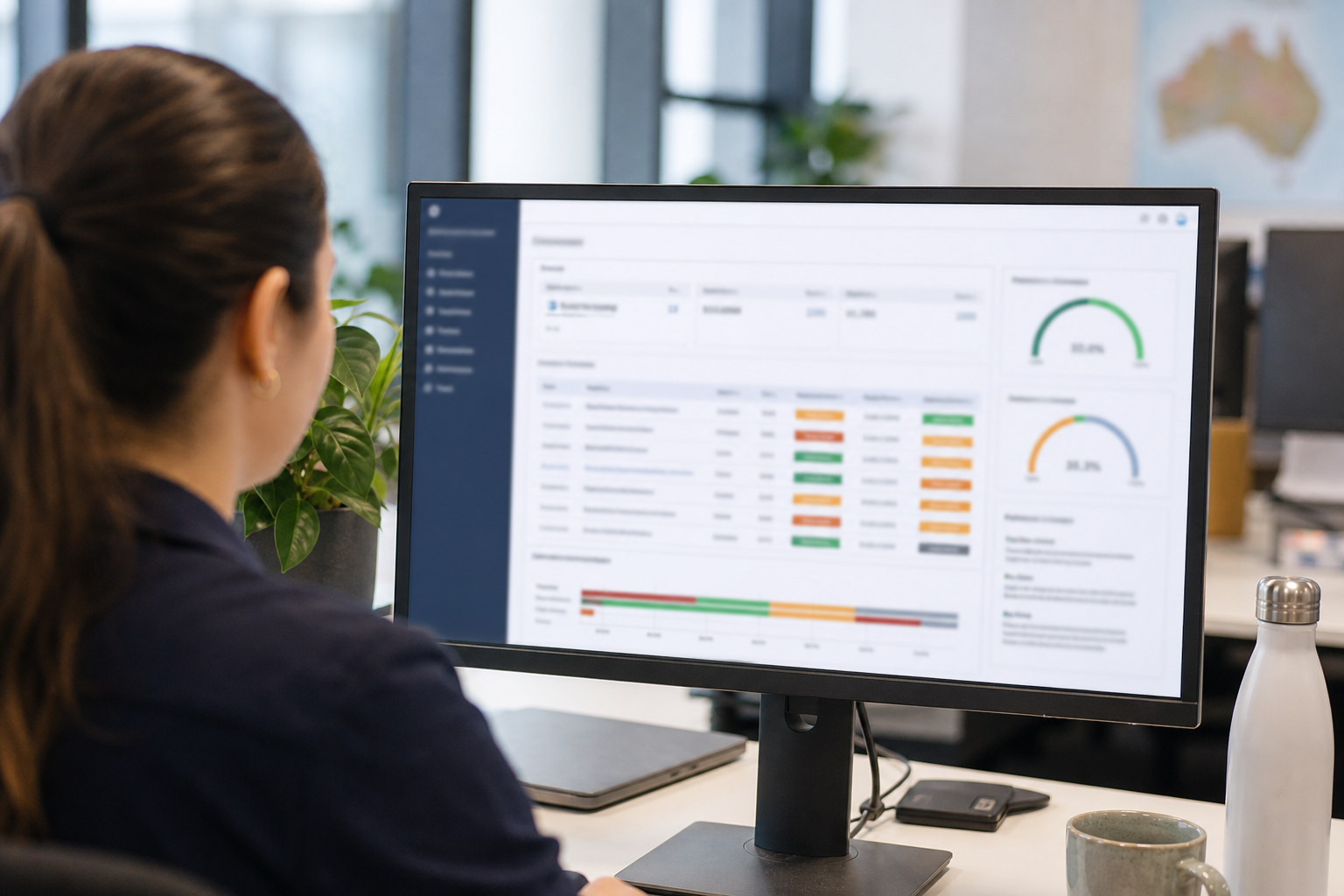
The portal introduced configurable approval workflows by job type and value threshold, with email notifications and in-app queues. Executive dashboards refreshed hourly with exception tiles linking directly to actionable worklists. Automated nightly exports to finance included validation reports flagging rows that failed mapping rules before they blocked billing runs.
Attachment handling standardised photo capture with automatic job linkage, timestamp metadata, and compression suitable for mobile upload. Audit exports packaged complete job histories — checklist answers, approver identities, revision logs — for regulator requests in minutes rather than days of assembly.
Measurable Outcomes
Within four months of full rollout across all depots, duplicate data entry hours fell by an estimated seventy percent based on time-motion sampling at three pilot sites. Average days from job completion to invoice-ready status dropped from 6.2 to 2.4. Monthly board reporting preparation reduced from two days to under four hours using built-in regional summaries. Support tickets related to "lost photos" or "missing approvals" declined by more than eighty percent compared with the prior quarter baseline.
The client retained Small Pea Software on a maintenance retainer for security updates, integration monitoring, and quarterly enhancement releases. This project illustrates how a focused operational portal can unify multi-site NSW services businesses without disrupting proven finance systems.
Beyond headline metrics, depot coordinators reported fewer end-of-day reconciliation disputes because job status definitions were finally shared between operations and finance. Executives adopted the portal as their Monday starting point rather than requesting ad-hoc spreadsheet packs — a behavioural shift that often matters more than a percentage on paper, because it means the system became the default reference rather than a parallel experiment.